Minibar Round 2:
What We Learned About Imagining Together

Alex Hillman
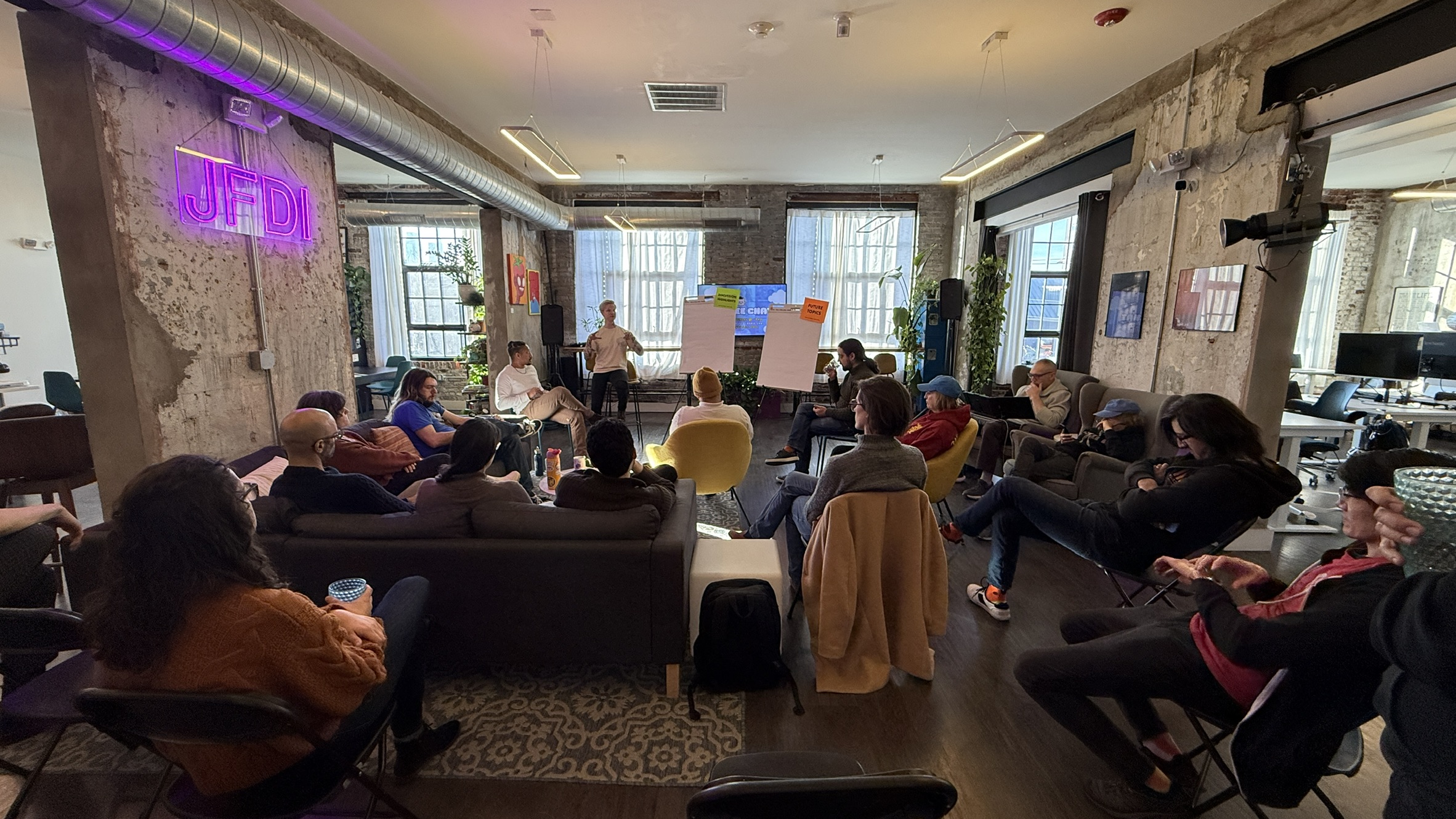
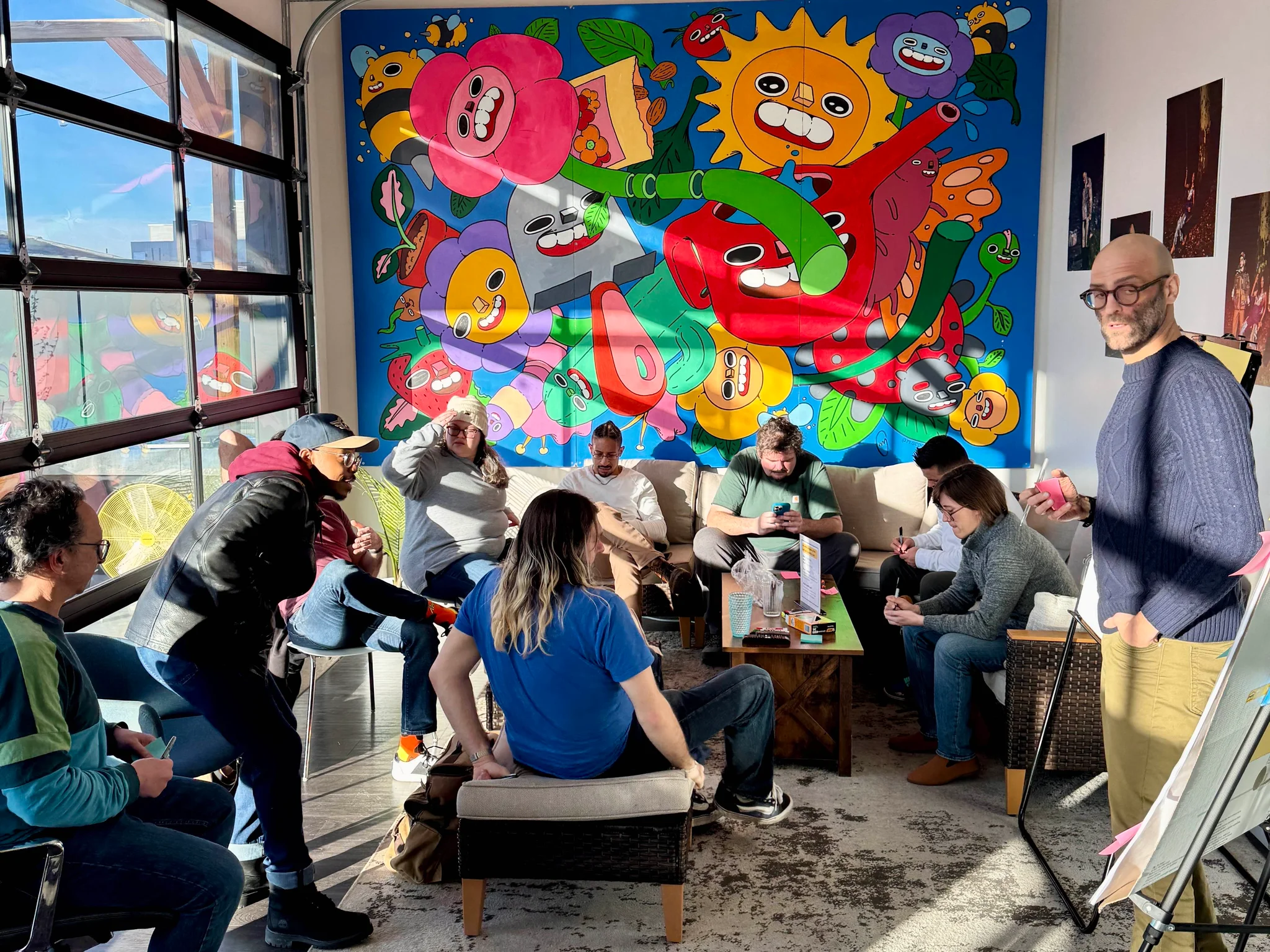
Last Friday we hosted our second ever “Minibar,” which is a Barcamp-inspired member-driven brainstorming session. From 3pm to 5pm on a Friday, we invited people to share ideas and observations about the Indy Hall community that can help us shape our community’s future.
It was a success - and for the second time in a row, we learned SO MUCH so fast.
And unlike our maiden voyage, this time we were much better prepared to share a recap of those lessons back with all of you.
How It Worked
In case you missed it, there were essentially 3 phases to Minibar.
First, a brief intro session with a bit of context-setting and background to help everyone understand why and how we were doing this sort of activity.
Then we broke into 2 groups, each going to a different area of the Indy Hall clubhouse for a ~20 minute rapid-fire brainstorming session based on a distinct prompt:
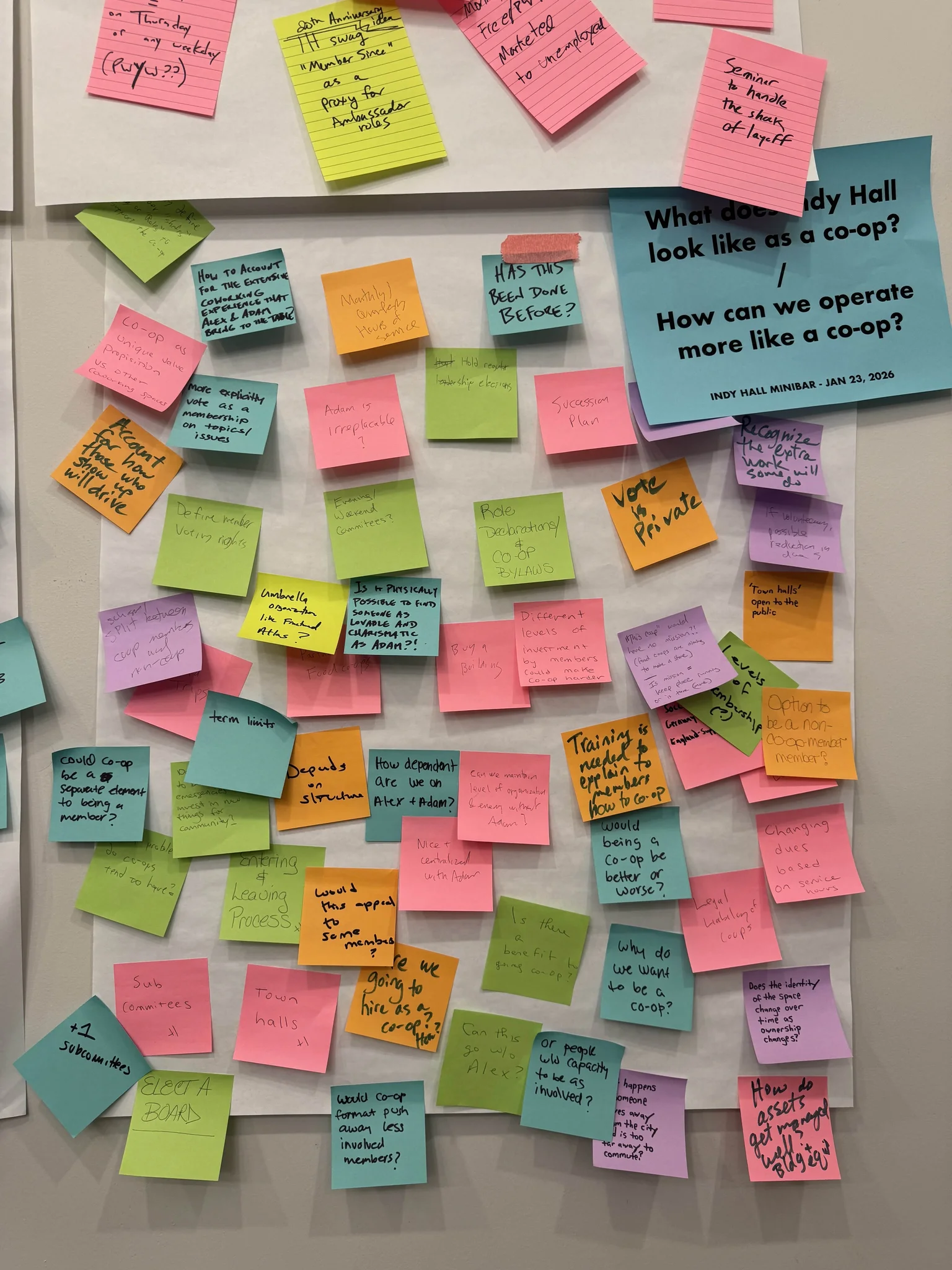
- How could Indy Hall operate more like a co-op?
- How can Indy Hall better serve people in work transitions?
Both of these questions are things that Adam and I reflect on often.
In particular, I think a lot about Indy Hall becoming member owned as one option for succession planning past myself. I can’t imagine selling Indy Hall to anybody except the Indy Hall community.
And every day, we see more and more people working through a whole range of work transitions. From switching industries, to weathering layoffs during a terrible job market, to intentional switches from traditional employment to self employment and back…Indy Hall has long been a place where people figure out what’s next.
So we wanted to know: how could we be more intentional about supporting people in these sorts of phases?
After each group had time with the first prompt and location, they rotated to the other one.
Finally, at the end we reconvened where we started for a recap and synthesis…which is where the real magic happened.

More on that in a moment.
The good news: this format works
While no solution will be perfect for everybody, we were thrilled to see that a daytime/weekday version turned out an almost entirely different crowd from the first one. At least 90% of attendees were first timers!
What’s especially cool is the range of people, from longtime members to folks who had just joined in the previous week. And the second time, we had a number of folks who primarily come to Indy Hall in the evenings for meetups and community events!
That’s exactly what we want - a range of ideas and perspectives.
And most of all, a way for people to get a better sense of how their Indy Hall experience is both similar and different from others.
Across both sessions and topics, roughly 30 people filled up our boards with sticky notes expressing their ideas, their questions, and more.
A “Bad Idea Board” positioned in each session also captured, well, the bad ideas.
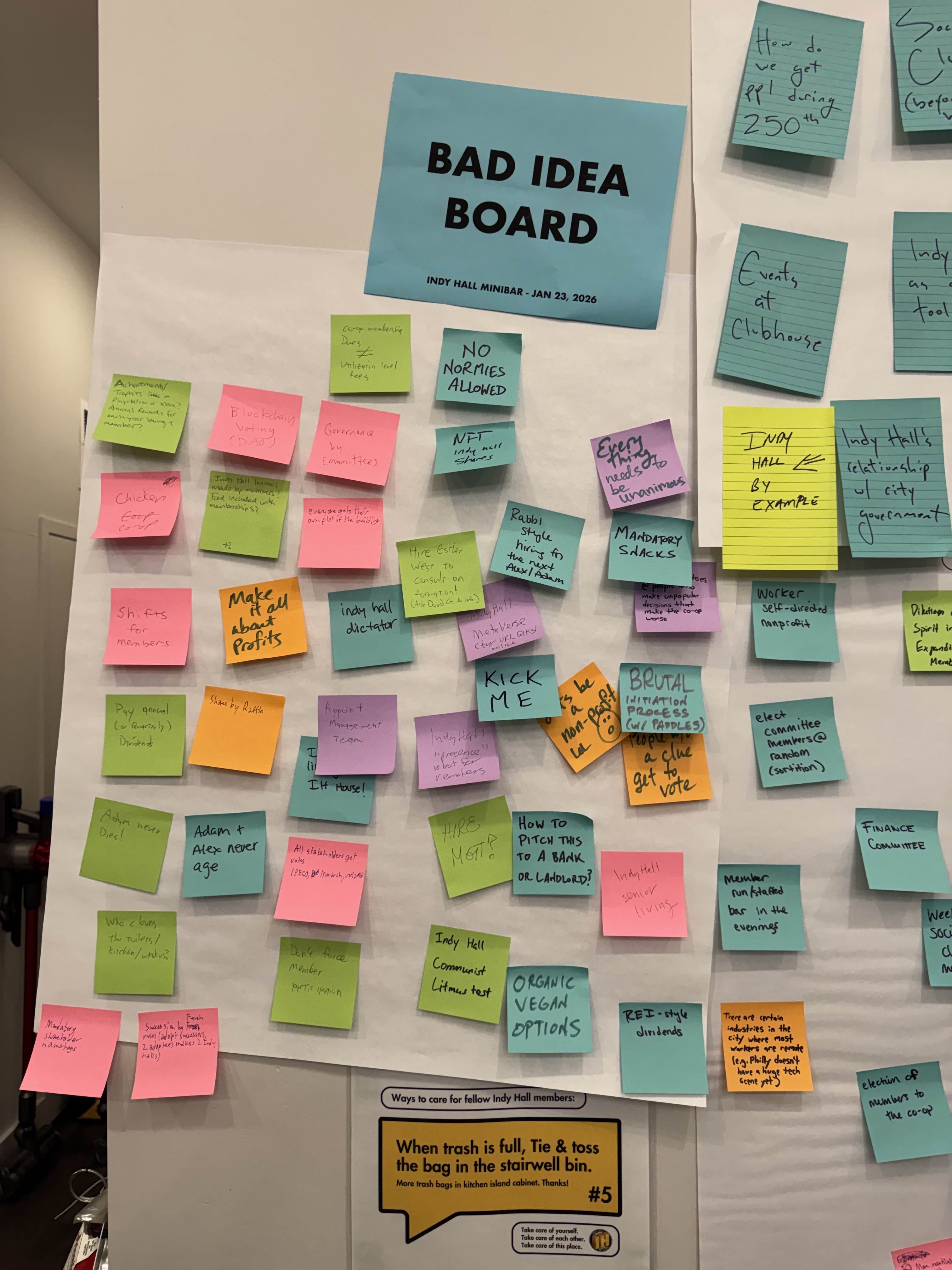
This is one of my personal favorite parts of Minibar, since the Bad Idea Board serves two purposes. First, it offers permission to that inner monologue that often keeps creative ideas inside. “This is probably a bad idea…” good! Put it on the Bad Idea Board.
But also, inside many bad ideas is a kernel of truth that can transform into an amazing idea. So we wanted to capture those as well.
Within less than an hour, the group had used SO many sticky notes that we had to switch to putting ideas on name tags at the very end. 😂
The Surprising Friction
While both sessions were filled with lots of good ideas and questions, it was clear that both groups approached the co-op question with a different energy.
I don’t think it was a bad question, but I do think our framing was off.
Some people were confused about what a co-op actually is. Others got so caught up in the legal mechanics of ownership (which are related and important!) that they had a hard time really dreaming about it like we hoped.
At the root of the problem? Two issues that we hadn’t really accounted for.
Issue #1 was that folks were worried that the things they love about Indy Hall would change. As one member put it perfectly:
“What if the thing that makes Indy Hall better for me, makes it worse for you?”
Issue #2 was even more unexpected though…because it led to a conversation about power.
In a perfect world, a co-op model is designed to distribute power among the member owners.
But in order to make that transition, we would need to examine our current power structures, both explicit and implicit.
This is a great conversation to have, but not necessarily one anybody knew they were signing up for, let alone trying to cram into a 25 minute group discussion!
Minibar Wrap Up Session: The Question Behind the Question
The real secret sauce of Minibar is that while the breakout sessions are important and valuable, it might not be for the reasons you think.
The breakout sessions are necessary and important pre-requisites for the FINAL session of Minibar, where the most vibrant conversations take place.
-
Where people share the patterns they noticed in their sessions
-
Where people call out their favorite ideas or clusters of ideas, so we might start turning them into reality.
-
And in the case of this discussion about power, where we can really start to unpack these themes and topics together among people who cared enough to bring them up in the first place
During the Minibar wrap-up session, several people suggested that the real question wasn’t “what if Indy Hall were more like a co-op” but instead…
“How can Indy Hall be immortal?”
Look. I know that sounds absurd, and we all had a good laugh.
But it’s closer to the truth about Indy Hall than you might think.
As we careen towards our 20th anniversary this September, I’m thinking a lot about the next 20 years.
I’ve long said that I want Indy Hall to exist for as long as people still want it to exist. For that to be true, Indy Hall should be designed to outlast any individual—including Adam and me.
And the way we do that is by building the structures, habits, and participation patterns that don’t depend on any one person and aren’t reactive to any one moment.
Think about how Indy Hall handled COVID.
We thrived more than most coworking spaces because we were already using Discord and Zoom for community connection—not because we saw a pandemic coming, but because those tools aligned with how we already believed community should work. When the crisis hit, we didn’t have to scramble. The infrastructure was already there, but so were the relationships needed to hold things together.
That’s what I mean by immortality.
We can build the muscles before we need them.
Whether it’s a co-op or some other structure, Indy Hall already prioritizes and practices things like participation, mutual support, and shared ownership. They’re already part of our DNA.
What happens when those things are more visible and accessible? I’m not sure, but I’m pretty sure good things happen.
The Exercise Is the Point
Here’s something I keep coming back to: the individual sticky notes are only part of why Minibar matters.
The bigger value is the exercise itself. Members talking to each other about what they care about. Thinking out loud about opportunities and priorities. Feeling like navigators of this community, not passengers.
That’s what makes Indy Hall different. And that’s what we’re practicing every time we do this.
Lessons for the next Minibar
With all of that said, Adam shared this list of lessons learned and ways we want to improve for the next one:
1. Make it a JFDI event. Minibar should feel like improv. Write your idea, slap it on the board, then explain it.
Don’t worry so much about how, just get the idea out of your head and onto the page.
2. Pick prompts that are broad, but familiar. During our first Minibar, one of our prompts was “merch ideas” and it turned out that it was almost too open-ended.
This time around the “co-op” question was too unfamiliar, and needed more information upfront than most people had.
The sweet spot for prompts here is probably somewhere in between—ambitious but accessible.
3. Stake out future dates now. We’re committing to quarterly Minibars for the rest of 2026.
This way we can start early work backward from each date, and involve members in the planning more too!
We’ll announce the next Minibar date once it’s set — keep an eye on the newsletter or the events page.
4. Don’t stop with sticky notes Just like the sticky notes are just the beginning and the real juice comes from the wrap-up session, the real impact comes when we start putting some of these ideas into action.
My goal for this and every Minibar is to produce at least one tangible thing we actually build or change. Something people can point to and say, “That happened because of Minibar.”
Looking Ahead
Watch for the next Minibar announcement — we’re running them quarterly throughout 2026.
In the meantime, if you were there on Friday - thank you. That includes:
Joe K, Meg, KT, Jessica, Lauren, Michael Y, Jason, Cathy, Ben, Lou, Anne, Danny, Michael S, Nick, Devon, Kim, Stef, Michael S, Joe R, Sean, Victoria, David, Millhouse, Cam, Mikey, Mal - if we missed your name, we absolutely didn’t miss your contributions!
If you couldn’t make this one - remember that these activities are only the beginning of a conversation, not the end! Ask us - or even better, a member who participated - about anything mentioned in this email or simply about their own personal experience.
And if you see those sticky notes still hanging in the kitchen, take a minute to read them.
Every one of them is a glimpse into how your fellow members imagine our future.
Don't miss our next post
Stories, insights, and community updates delivered to your inbox weekly.